Biography
She learned to write
in a drawing office
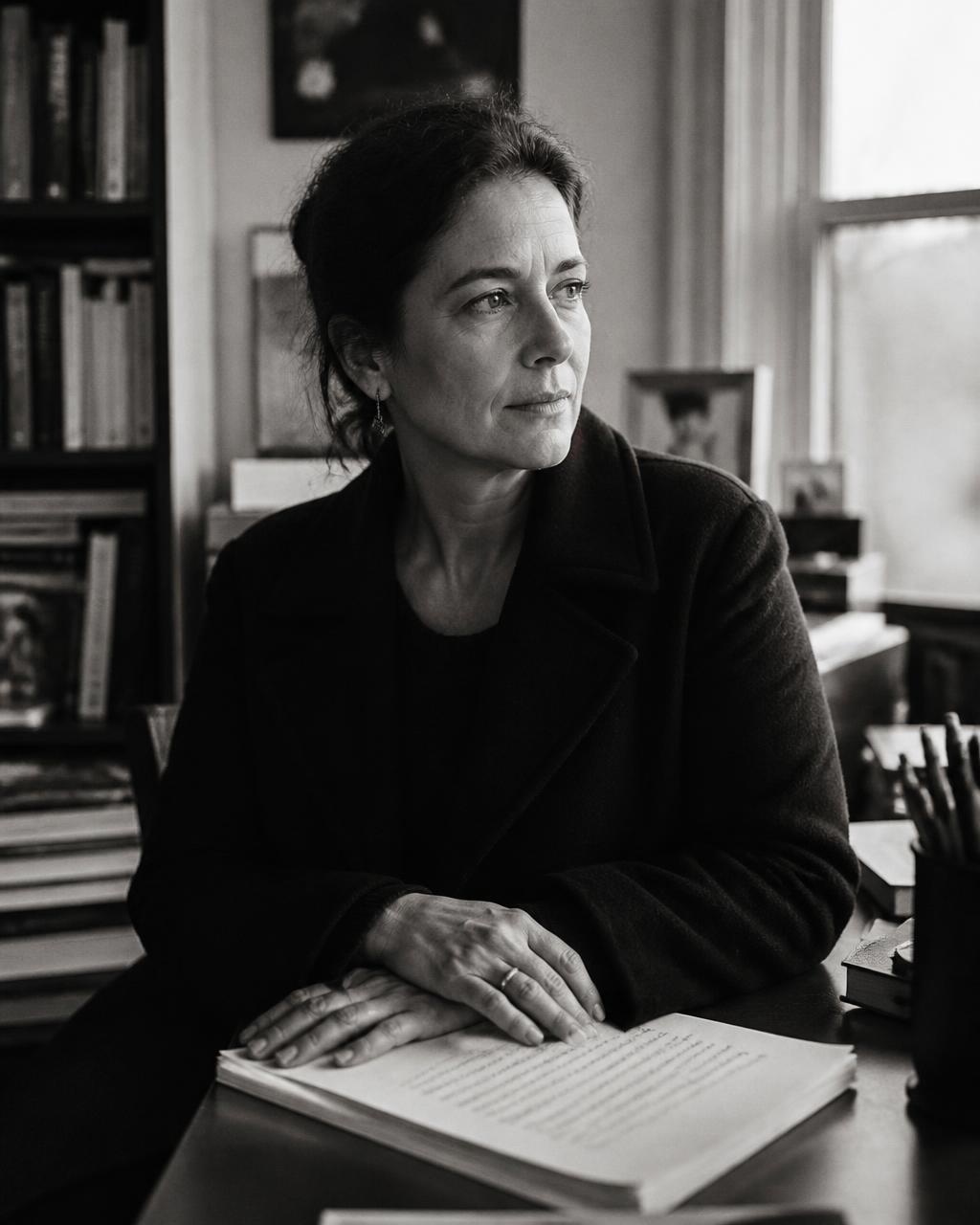
Mara Vell spent a decade describing cracks in concrete before she ever described a person. It shows — and she considers that a compliment. This page holds the long biography, the working method, the honours, and everything a programmer or journalist normally has to email and ask for.
- Born 1978, Berwick-upon-Tweed
- Lives in the Hudson Valley
- Represented by Ashcroft & Vane
Mara Vell writes about measurement, and about the people who stake their lives on it. Her four books circle a single question — what does it cost to insist that something is true, and what does it cost to let the insistence go — and they take that question to estuaries, salt works, bridges and survey offices rather than to courtrooms or laboratories.
She grew up in the back room of her father's land-survey practice in Berwick-upon-Tweed, doing homework on a light table. The vocabulary of that room — datum, tolerance, revision, error — became the vocabulary of her fiction. She has said in interview that she did not choose the subject so much as fail to escape it.
After ten years writing bridge inspection reports for a civil engineering consultancy, she published a slim essay collection, The Cartographer's Hand, with a press that ran it off in a room above a bookshop. Her debut novel, Paper Bridges, followed in 2019 and won the Aldermere First Book Award. Salt Rooms (2022) was shortlisted for the Fenwick Prize and has been translated into fourteen languages.
Her fourth book, The Quiet Meridian, appears in November 2026. She lives in the Hudson Valley with an excessive number of Ordnance Survey sheets and one bad-tempered lurcher, and teaches one term a year because she likes being asked hard questions by people who have not yet learned to be polite about it.
Three things she is asked constantly
- Do you draw the maps in your books?
- Yes, badly, on purpose. A map drawn well is an argument you can't see. A map drawn badly admits it is a claim.
- Is the survey office in The Quiet Meridian your father's?
- The furniture is. Nothing else. He has read it and told me only that the print machine is the wrong model.
- Why so much weather?
- Because the weather is what happens to a measurement after you've taken it.
A working life, in seven entries
- 1978
Born in Berwick-upon-Tweed
The second child of a land surveyor and a school librarian. Grows up in the back office of a drawing practice that smells permanently of ammonia print.
- 1996
Leaves for geography, returns with poetry
Reads geography at Durham, spends most of it in the literature section, and graduates with a dissertation on the coastlines that early Ordnance surveyors invented to fill blank plates.
- 2001–2011
Ten years in the trade
Works as a technical editor for a civil engineering consultancy, writing bridge inspection reports. Learns, she says, everything she knows about sentences from having to describe a crack precisely.
- 2016
The Cartographer's Hand
A first book: fourteen essays, 900 copies, one very small press. It sells out in a year and is passed hand to hand among surveyors.
- 2019
Paper Bridges
The debut novel, written across four years of night shifts. Wins the Aldermere First Book Award; the acceptance speech runs to eleven words.
- 2022
Salt Rooms
Shortlisted for the Fenwick Prize and translated into fourteen languages. Vell leaves the consultancy for good.
- 2026
The Quiet Meridian
The fourth book, and the first she describes as finished rather than abandoned.
“I don't write about landscape. I write about the paperwork people leave behind when they've finished arguing with it.”
How she works
Vell writes in the dark half of the day, in pencil, on gridded paper left over from the drawing office. The rules below are hers, offered without much confidence that they transfer.
She also teaches this- 01
Describe before you decide
Two pages of pure description of a place before a single character is allowed to want anything in it.
- 02
Keep the error log
Every draft carries an appendix of things she got wrong. It is longer than the acknowledgements and considerably more useful.
- 03
One fact per scene, verified
Tide tables, gauge readings, ferry timetables. If the fact is wrong, the scene is deleted rather than repaired.
- 04
Read it to a wall
Every chapter read aloud, standing up, to nobody. Sentences that need a run-up get cut.
- 05
Stop mid-sentence
The day ends in the middle of a line, so that tomorrow starts with a repair rather than an invention.
Awards & honours
- 2023Fenwick Prize — shortlistSalt Rooms
- 2023Estuary Society Medalfor writing on landscape
- 2022Wintergreen Book of the YearSalt Rooms
- 2020Aldermere First Book AwardPaper Bridges
- 2017Small Ordnance Essay Prize“My Father's Drawing Office”
Press kit
Please use one of the two approved biographies below verbatim. Photographs are available at print resolution on request; the credit line is not optional.
Short bio — 32 words
Mara Vell is the author of three novels and a collection of essays, including the prize-shortlisted Salt Rooms. Her fourth book, The Quiet Meridian, is published in November 2026.
Long bio — 71 words
Mara Vell was born in Berwick-upon-Tweed in 1978 and spent ten years as a technical editor before publishing The Cartographer's Hand in 2016. Her debut novel, Paper Bridges, won the Aldermere First Book Award; Salt Rooms was shortlisted for the Fenwick Prize and translated into fourteen languages. She teaches one term a year, lives in the Hudson Valley, and is at work on a fifth book about a lighthouse keeper's logbooks.